 Margen
Serialized book · From the Margen catalogue
Águeda lays the thirty-one prescriptions on the counter
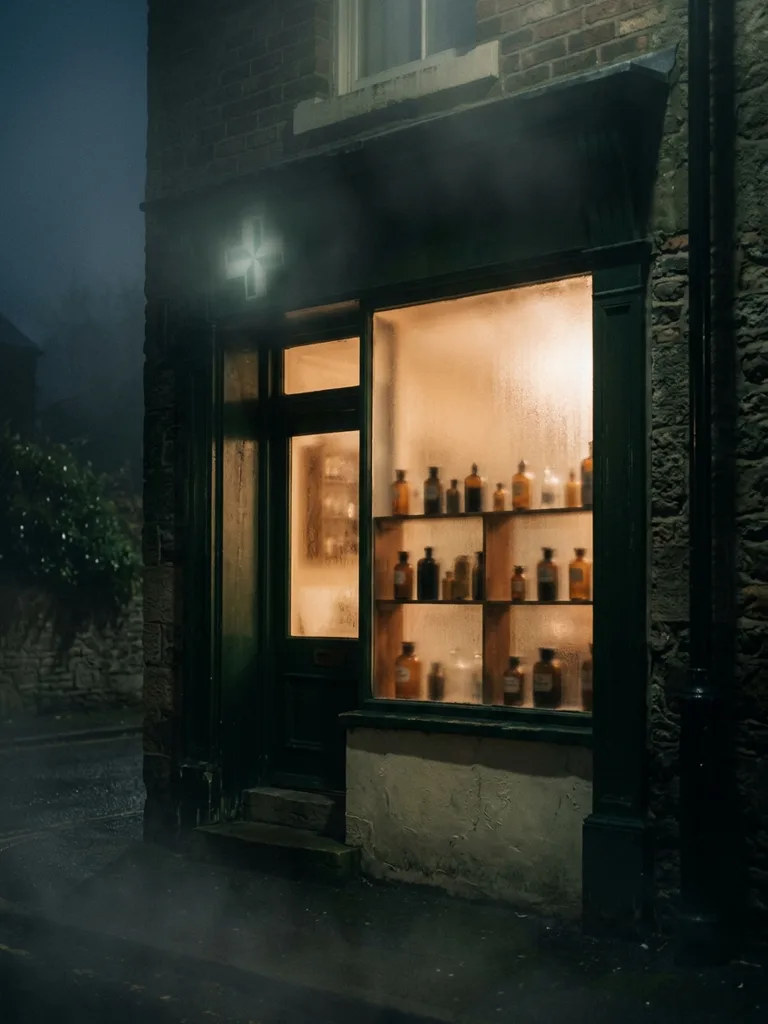
Previously: Rosalía Sagasti, retired nurse, burned the nine blank prescriptions and handed Águeda the grey notebook, the pad covers and the stamp.
The 26th dawned in fog, zero days left, and the pharmacy shutter went up at half past seven, an hour and a quarter earlier than the sign says. Águeda Mendioroz, licensed owner of the only pharmacy in Valdecierzo, had not slept and did not pretend otherwise.
On the counter, in a row that took up a metre and a half of the wood, lay the thirty-one prescriptions: the copies the billing system returns to you, sorted by date, each with its serial number showing. Beside them, the green covers of the prescription pad. Beside those, the surgery's rubber stamp, face up, its ink dry. Beside that, the grey notebook, open at the first page, with the sheet Rosalía had taped inside on Sunday. And on top of everything, a page Águeda had written by hand in the small hours, with her name, her registration number and eleven lines.
She had swept the floor twice.
At a quarter past eight Petra Aldunate came in, pharmacy inspector for the health district, in a long coat and carrying a ring binder, and behind her Marcial Beloki, technician at the district management office, the billing one, the same man who had picked up the phone four days earlier, on a Friday at a quarter past nine, to tell Águeda that nobody had called the inspection: that what there was, was a cross-check.
"Good morning," said Petra. "We're here to review the prescription file for the last financial year and—"
She stopped. She was looking at the counter.
"They're all there," said Águeda. "All thirty-one. You don't have to look for them."
Petra set the binder down in the free space beside the till and took off her gloves slowly. Marcial Beloki pulled out a laptop and never got as far as opening it.
"Are you telling me you had them ready?"
"I'm telling you I dispensed them, one by one, and that I have spent fourteen days finding out who was signing them. I found out on Friday. It's written there, in the notebook, in the handwriting of the person who signs it." She pushed the handwritten page two centimetres towards her. "And this is what I'm handing over myself, in case the order matters."
Petra read the page standing up, without sitting down, and said nothing until she reached the end. There were eleven lines and each one was a name with a date in front of it: the first time Águeda had dispensed to that person a prescription signed by Braulio Sagasti after March 2024. The first line was the fifteenth of July of that year. The last was three weeks ago. Underneath, a single sentence: "I dispensed all thirty-one myself. Nobody put a single one in my hand by deception." Then she read the sheet taped inside the grey notebook. The date, the twenty-fourth. The thirty-one serial numbers. And the line at the bottom: "I signed them. Rosalía Sagasti Aldaz, nurse."
Petra Aldunate had spent seventeen years walking into pharmacies with that binder and she knew how these mornings begin. They begin with an owner who is not there, with a file that got wet, with a computer that happens to be throwing errors that very week. The worst of them was a pharmacy on the coast where the owner was selling opioid prescriptions for cash, and that morning it took her four hours to be shown the first folder.
Here she had been nine minutes and had the complete material in front of her, sorted by date, with a signed confession on top.
"I can't skip over this," she said. "You giving it to me before I ask doesn't erase it."
"I'm not giving it to you so you'll erase it," said Águeda. "I'm giving it to you so you don't have to go looking, which is different."
"Where is this woman?"
"She's coming at nine," said Águeda. "I asked her and she said yes before I finished the sentence."
At ten to nine the door bell rang twice in a row. The first was Simón Goñi, the baker, who takes the bread up to the high quarter on Thursdays and who had gone out of his way that day to leave four loaves and collect the weekly pill boxes; he looked at the counter, looked at Águeda, left the bread on the stool and went out without saying a word, which was exactly the right thing to do.
The second was Rosalía Sagasti. Seventy-one years old, nurse at the Valdecierzo surgery for thirty-four of them, retired for the last three, exactly six months before her brother died, sister of the doctor who had signed those prescriptions two years after his death. She was wearing her good coat and carrying a cloth bag with two things in it.
"Rosalía Sagasti," she said. "Registration one thousand one hundred and four. Shall we start?"
Petra Aldunate pointed her to the stool and Rosalía did not sit down.
She told it standing and in eleven minutes, without anyone having to ask her the same thing twice. In March 2024 her brother Braulio died, rural doctor at the surgery for thirty-one years. The post was never filled. The district doctor took Valdecierzo on from the clinic twenty-two kilometres away, two mornings a week, with no records and a full diary. What stayed behind in the surgery were the patient cards, the medicine cabinet and, inside the cabinet, a pad of official prescriptions and a stamp that the equipment-collection report listed as withdrawn and that the van never came for.
At that point there were eleven people in the village, all of them over seventy-five and all living alone, who had been taking the same thing every day for between seven and thirty years: digoxin, furosemide, Sintrom, slow insulin, iron. Rosalía knew the regimens by heart and had them written down since 1991 in a grey notebook she had started herself the year she was left alone doing the dressings, with the doses, the allergies, who had stairs at home and who had nobody to come up and check on them.
"And in July Balbina ran out of digoxin," she said. "Balbina Ochandiano, eighty-four, retired cattle farmer, up in the high quarter. Appointment with the district doctor: twenty-nine days. I had the notebook, I had the pad and I knew how to sign like my brother, because I wrote the surgery's prescriptions for twenty years with his signature in front of me, so that he could check them and sign them afterwards. So I did the same thing I had done all my life, only without him behind me."
"Did you take money for it."
"Nothing. Not a peseta, not a favour, not a Christmas ham. You can look at my bank account whenever you like and I'll sign the authorisation right now."
"Did you prescribe anything new?"
"Nothing new. Renewals of what they were already taking, and in two years I changed three things: I moved Balbina's digoxin from night to morning and took away her sleeping pill because she fell at dawn with a pulse of forty-eight; I put Amadeo Etxarri's furosemide on alternate days because his ankles swelled in the heat; and I took Fermina Larrañaga off iron because it shut her stomach down. All three are written in the notebook with the date and my initials on the day I did them. There is no fourth."
"That is the most serious thing you have told me."
"I know. That's why it's written down."
Petra Aldunate asked for the grey notebook and started cross-checking it against the prescriptions on the counter, one by one, out loud, while Marcial Beloki ticked them off on a spreadsheet. It took them fifty minutes. Eleven names, thirty-one dispensings, none repeated within the same month, none out of date, none for a medicine that was not already on the patient's card before March 2024. Fermina Larrañaga, seventy-nine, iron and Sintrom: four prescriptions. Amadeo Etxarri, eighty-one, furosemide: five. Anselma Redín, eighty-two, retired schoolteacher, slow insulin: four. Balbina Ochandiano, digoxin: four, the last one from two weeks ago. And so on to thirty-one.
At number nineteen, Águeda stopped.
"I dispensed that one on a Tuesday in February at twenty to ten," she said. "I remember because Balbina stayed while I filled her pill box and told me the blue bottle no longer went in the evening slot. The blue bottle was the sleeping pill. She said it to my face and I filled the slot and I did not ask why it had disappeared."
"You had no reason to ask," said Petra.
"I had a dead man's prescription in my hand and the woman telling me her regimen had been changed. I had every reason to."
Marcial Beloki then explained his half of the answer. Until this year the file of dispensed prescriptions was only cross-checked against practitioners on the active register. The check against cancellations — retirements, transfers, deaths — was brought in in January, once a quarter, and the first one came out in April. Thirty-one came up, all with the same number: 31.0448, cancelled on death since March 2024. The alert went out on the fourteenth of April with forty-two ahead of it in the queue and three people to work through them. The twenty-sixth was the day that had fallen to the Valdecierzo pharmacy, no more and no less.
"So nobody in the village called today's inspection," said Rosalía.
"Nobody called it. A file cross-check threw it up," said Marcial.
Petra Aldunate drew up the report at twenty past ten, on the counter, with Marcial Beloki typing and Águeda standing on the other side, in the spot where she serves. The report recorded, in this order: the list of the thirty-one dispensings with their serial numbers and dates; the pad covers with the two serials, matching the April report signed by the town clerk; the stamp; Rosalía Sagasti's handwritten statement; the grey notebook, with the three entries initialled "R. S."; Águeda Mendioroz's handwritten statement; and one line that Rosalía dictated and Marcial wrote down word for word: that nine sheets were missing from the pad and that she had burned them in her own kitchen on Sunday the twenty-fourth, with the pharmacist watching.
The covers and the stamp were sealed in a bag with all four signatures crossing the closure.
Petra told them out loud, so that it would be on record that she had said it, what came next and what did not. That signing an official document with somebody else's name has a name in the criminal code, and that she does not decide that: a court does, if the district management takes it there. That Rosalía Sagasti also faces proceedings from the nursing council. That Águeda Mendioroz's pharmacy faces proceedings of its own for having dispensed thirty-one prescriptions from a dead prescriber, and that handing everything over voluntarily does not prevent that, although it weighs. And that neither of those things gets settled that morning or in that room.
"And until it is settled?" asked Rosalía.
"Until it is settled, you never touch a prescription pad again as long as you live, and the pharmacy stays open."
The report also carried a proposal, which was the only thing on that counter that could be called a decision. Petra Aldunate proposed referring the file to the district management and to the professional council, and noted as circumstances to be considered that there had been no profit, that there had been no new prescribing beyond three adjustments documented on the day, that no patient had suffered any known harm, and that the pharmacy's owner had handed over the complete material before being asked. Marcial Beloki added, for his part and in writing, two dated commitments: that the management would reopen the Valdecierzo surgery two days a week with the district doctor from the fifteenth of the following month, and that the delivery of the weekly pill boxes to the high quarter would be recorded as a service, with who does it and at what time, instead of existing because a baker goes up on Thursdays.
At a quarter to eleven Balbina Ochandiano came in for her pill box. She saw four people standing round a counter covered in paper and asked what anybody would ask.
"Has something happened?"
"That from the fifteenth you'll have a doctor here two days a week," said Águeda. "And that this week's digoxin is in the morning slot, as it has been since February."
Balbina took the plastic box with its seven compartments, put it in her bag and stood for a moment looking at Rosalía, whom she saw in the street every month and whom she had not seen inside the pharmacy for years.
"Good morning, Rosalía."
"Good morning, Balbina. Take the morning one with your breakfast, not on an empty stomach."
"Same as always," said Balbina, and off she went with her bag pressed against her side, down Doctor's Street, which has been called that since before there was a doctor.
When the door closed, Petra Aldunate turned the report round on the counter and took the cap off her pen.
Rosalía signed the report with her full name, registered nurse 1,104, and underneath, for the first time in two years, nobody else signed.