 Margen
Serialized book · From the Margen catalogue
Two prescriptions turned away at the roadside pharmacy
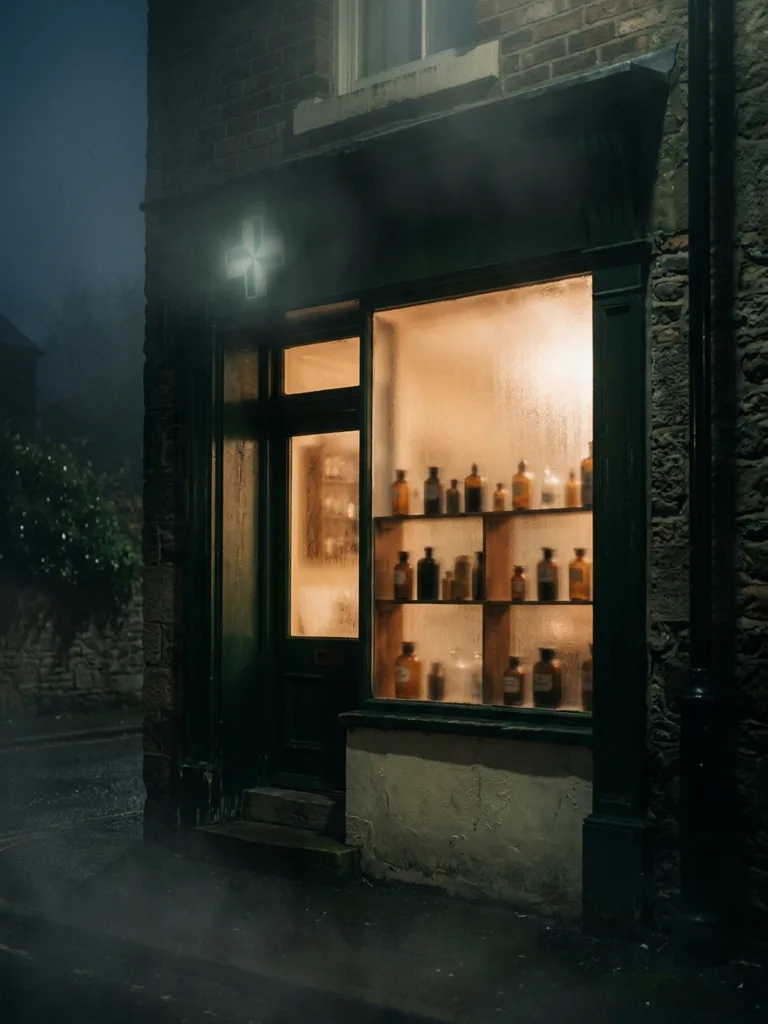
Previously: eleven people in Valdecierzo who live alone take medicines prescribed by Doctor Sagasti, dead since 2024. Águeda keeps thirty-one prescriptions.
On Tuesday the 19th, seven days before the inspection, Marcial Beloki, billing officer at the area health authority, rang the chemist's at a quarter past nine to correct himself.
"The zero is good," he said. "Two years of billing, all nine pharmacies in the area, not one prescription with licence number 31.0448 outside yours. But the day before yesterday, in Sunday's email, I gave it more weight than it has."
Águeda Mendioroz, the pharmacist of Valdecierzo, leaned on the counter with the phone wedged between her ear and her shoulder. The clock on the wall, which has run four minutes fast for as long as she can remember, said nine nineteen.
"Say it to me again, then."
"A rejected prescription is never billed. If somebody took one to another chemist's and it was handed straight back, it has never existed on my screen. My zero says nobody charged for them. It doesn't say nobody tried."
Águeda stared at the laboratory calendar, the one with the lavender field, its days crossed off up to the 18th.
"I took it for granted that any of the other eight would have dispensed them without looking twice," she said. "A piece of paper with a stamp and a signature. Nobody knows dead doctors' licence numbers by heart."
"Then ask them yourself, they'll tell you. They answer me in writing and it takes a fortnight."
"I will. And do something for me: look up in the gazette everything there is on the patient transport for Valdecierzo since the surgery closed."
"What for?"
"To know since when these people can't get anywhere."
She hung up at half past nine. In the squared notebook, beneath Sunday's two questions, she wrote a third: who said no.
The area has nine pharmacies counting her own, and Águeda knows them by the order of the on-call rota. Seven of the other eight are more than twenty kilometres away, in villages you can only reach from Valdecierzo with your own car or on the area transport, which goes down at eight and comes back at three. The eighth is nine kilometres off, at the main road junction, has a car park at the door and closes at nine at night. If any of the eleven had tried somewhere else, it would have been there.
She called at ten, between two customers. Itziar Lizarraga, who has owned the pharmacy at the junction for eleven years, was putting away the morning order. Águeda gave her just two things over the phone, a surname and a licence number, and asked her to look back. Itziar told her to come by at closing, that she would be doing the till until half past nine.
Águeda locked up at twenty to nine and reached the junction at five to nine. The pharmacy at the junction is a corner unit, with two windows onto the main road and the green cross on a tall post that you can see a kilometre before you get there. Inside there were white strip lights, a sun cream display still up and a young girl running a mop between the shelves. Itziar waited for the last customer to leave, opened the glass door for her at nine on the dot and bolted it again from inside.
"Sagasti," she said, before Águeda had reached the counter. "Braulio Sagasti, 31.0448. I looked it up the moment you hung up. Twice."
She had both of them written down. In the back room, on top of the computer, she keeps a red-covered notebook where she records what she turns away: date, medicine, reason and who brought it. She started it the year she had a disciplinary file opened over a misread authorisation, and she has never stopped since.
"Sixteenth of November 2024," she read. "Paper prescription, handwritten, anticoagulant for Higinio Belzunegui Sola, eighty-six, resident in Valdecierzo. Turned away."
"Why?"
"For three things at once, and any one of them would have been enough." Itziar raised her thumb. "One: it was handwritten paper, and handwritten paper I type in myself. When I entered the licence number the program threw up a warning: professional not active in the register. Two: the woman bringing it was not the patient, she had neither his health card nor a paper signed by him. And three, which is the one that really counts: I have never in my life seen that man. A hundred and fifty people come in here a day and I don't know a soul from Valdecierzo."
"And what did you tell her?"
"To take it to the area health centre and have the doctor he is assigned to renew it. I told her nicely. She put it in her bag and left."
She turned three pages.
"Eighth of March 2025," she went on. "Same woman, another name: Ramona Elizalde Vidaurre, eighty-four, drops for eye pressure. Same paper, same handwriting, same licence number. And that time I did look twice, because it made no sense to me that the same thing should happen to the same person twice. I asked her for a phone number for the patient. She told me the lady doesn't hear well on the phone. And at that point I said no, and not to come back with that paper."
Águeda said nothing for a while. The girl with the mop had reached the door of the back room and turned round.
"I thought anybody would have dispensed them," she said at last.
"Not one of the other eight, Águeda. A handwritten paper, a licence number the program doesn't recognise and a lady who isn't standing there. Even the August locum hands that back." Itziar closed the red notebook. "In yours nobody handed it back because in yours the lady is the lady you've known all your life and you know what she takes without looking at the box. None of the other eight has that."
"What was the woman like?"
"Early forties. Dyed blonde, ponytail. Parked right at the door, both times, in a grey Ibiza. The second time she had a green medical tunic under her coat, the sort they wear in care homes. And she comes in here, mind you, every fortnight for her own things; what I don't know is her name."
Águeda went out to the car park at twenty-five past nine and stayed inside the car with her hands on the wheel. There is only one person in Valdecierzo who goes down to that pharmacy because she can park at the door.
She called Maribel Zubiri at twenty to ten, from the hard shoulder, with the engine off. Maribel is a care assistant at the residential home in Tafalla, she is forty-three and she comes down to the village at weekends to see her mother, who lives on Fronton street, three doors below Higinio Belzunegui's.
"Oh, yes," Maribel said at once. "I went down both times. The first time Higinio Belzunegui asked me, the road mender: he hasn't come down to the village since they operated on his hip, and there's a slope up to your chemist's that he can't manage. The second time Ramona Elizalde stopped me in the doorway."
"Maribel, where did those prescriptions come from?"
"Out of their own letterboxes, both of them. An envelope with no sender, with the paper inside. Higinio showed it to me and told me it was from the doctor. The first time I didn't even look at the signature, that's the truth. The second time I did, and I thought it was odd, but the woman was halfway through her drops and I felt sorry for her."
"And afterwards?"
"Afterwards I gave them back to the two of them and told them to take them down to yours, that at the junction they wouldn't take them. And neither of them asked me again."
Águeda drove back to the village along the main road, parked in front of the pharmacy and went in without turning on the light in the shop. She switched on the back-room computer, which sounds like a vacuum cleaner, and took the blue folder out of the second drawer.
Thirty-one prescriptions, each with its date written in soft pencil in the corner in her own hand. That night she sorted them by something else: by how they had arrived.
Six of the thirty-one never reached the pharmacy. They reached the houses, in envelopes with no sender, in the first eight months, and they were brought down by the patients or by whoever could bring them down. Two of those six are the ones Itziar Lizarraga turned away at the road junction.
The six come from four different houses: Belzunegui, Elizalde, Baraibar and one of Anselma Redín's, the retired schoolteacher, from October 2024. None is Balbina Ochandiano's, who lives up in the high quarter, in a house with two flights of stairs and a broken doorbell, and to whom Simón Goñi, the baker, carries the bread and the pill organiser on Thursdays. Águeda counted the months: the last of the six is dated March 2025. Since March 2025 no envelope written to the person living inside has reached a single house in the village.
The remaining twenty-five were addressed here, to this shop, typed: Farmacia. Valdecierzo. One of them, Celedonio's, the postman left by mistake at Balbina's house twelve days ago, but the envelope was not for Balbina. She had always opened the letterbox envelopes standing up, with the parcel knife, without turning them over: since that one, she had taken it for granted that none of them carried a stamp. Eight of them did. With Celedonio's, nine.
Nine carry a stamp and the postmark of the Valdecierzo sub-post office. The sixteen that are left carry no postage of any kind: they never went through the post. Somebody dropped them into the letterbox on the shutter.
Águeda laid the sixteen out in a row on the counter and looked at the dates in the corners. On Wednesday, with all thirty corners laid out in front of her, she had seen Mondays everywhere and had taken it for the rule of the house. The Mondays belonged to this pile.
Thirteen of the sixteen she had taken out of the box herself on a Monday, on opening, at a quarter to nine.
At ten past eleven at night Marcial Beloki's email came in with a four-page pdf and one line above it: "This is what you asked me for this morning. It comes from the gazette, it's public." Resolution 214/2024 of the area health authority, dated 28 June 2024, in force from the first of July: the non-urgent patient transport route for Valdecierzo went from three days a week to one.
Águeda gathered the sixteen off the counter, put them back in the blue folder and opened it at the first sheet, the one right at the top. She read the date she had written in pencil in the corner two years earlier: Monday, 15 July 2024. Between the first Monday on which Valdecierzo was left with a single trip a week and the dead doctor's first prescription there were fourteen days.