 Margen
Serialized book · From the Margen catalogue
Aitor opens the woodshed and there is a man inside
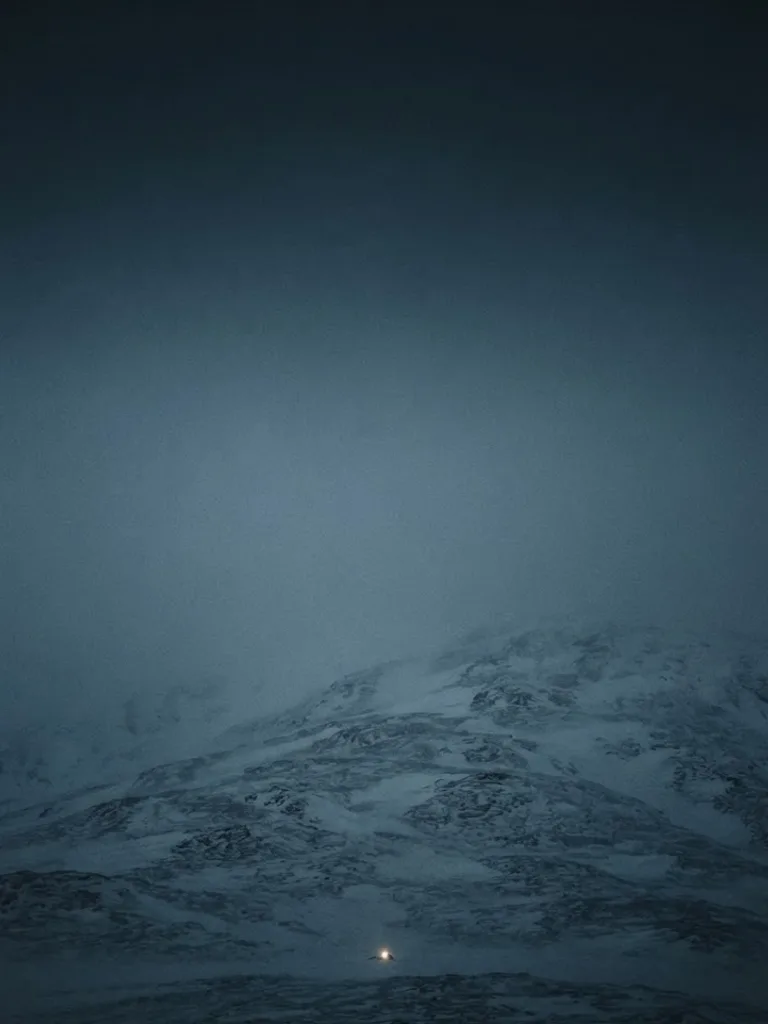
Previously: an avalanche cut off the Iratxeta mountain hut with eight people inside. The signing book holds nine names.
The third day dawned with diesel for ten days. Idoia Bergara, warden of the hut and an emergency nurse until 2019, went down the eight steps that separate the dining room from the woodshed with the battery lamp in one hand and the bunch of keys in the other, even though the woodshed is never locked: the keys are for the generator room, and she does not let go of them.
Behind her came Ramiro Bouzas, mountaineer and boatbuilder, with a snow shovel and a mallet, and Aitor Sein, seventeen, doing his warden's apprenticeship that season. The rest stayed upstairs because Idoia ordered it that way: eight people crammed onto a staircase help nobody.
The Iratxeta woodshed is a low room, three metres by four, cut into the hillside and roofed with the same slabs as the rest of the building. It has two ways in. One is the inner staircase, which starts in the dining room and ends at a plank door that opens inwards. The other is the west hatch, a trapdoor barely a metre across through which firewood is pushed in from outside without entering the hut. It is one of the two openings that can be worked from outside on their own; the other is the equipment store.
Txomin Elordi, sixty-two, shepherd, who has carried the club's post up to Iratxeta since 1994, had put his head round the stairwell before they went down.
"The avalanche came down from above and swept the north face and all the upper west side," he said. "But the hatch is right at the bottom, under the spur. The snow goes over it there and does not load on it."
"Can it be opened from outside in this snow?"
"If you know where it is, yes, with your hands. And you have to know, because you can't see it from the path: you have to go round the building from below, hugging the stone."
Idoia wrote that down in her red-covered notebook before going down, because the things Txomin knows are recorded the same way as the things an instrument reads.
The plank door did not open. Idoia pushed, pushed again with her shoulder, and the leaf gave two fingers' width and stopped.
"It's jammed from inside," said Ramiro.
"There's no bolt on the inside," Idoia answered. "There's firewood."
They checked by pushing the lamp through the gap. Behind the door was a heap of collapsed logs, the ones from the back stack, which had come down with the shock of the avalanche and ended up leaning against the planks. Ramiro pulled out the ones he could reach by hand, one at a time, passing them to Aitor, who piled them on the landing. It took them fourteen minutes to open half a metre of gap.
Aitor went in first because he was the one who fitted. Idoia thought about it for two seconds before letting him, and she said those two seconds out loud, which is how things are said in a mountain hut:
"You go in, you look and you come out. You touch nothing. If there's anything, you call me."
The boy squeezed in sideways, lamp first. Idoia heard his boots on the timber, heard him stop, heard him say nothing for several long seconds, and then heard his voice, which came out higher than he would have wanted.
"Idoia. There's a man."
He was in the west corner, under the hatch, sitting on the bundles of kindling and covered to the neck with two hessian sacks of the sort used for carrying ash down. His head had fallen towards his right shoulder. He did not move when the light hit his face.
The first thing Idoia saw, before the face, was how he was arranged. He had not collapsed: he had sat down, put the bundles underneath so as not to touch the stone floor, pulled the sacks over himself starting at the feet, and tucked his hands into his armpits. That is what a man does when he knows what is happening to him. Someone who faints from cold falls sideways and stays as he falls.
His hair, white and short, glittered with frost at the tips. His boots, stitched-soled and at least fifteen years old, were properly laced. He had two or three days of beard. In his right hand, hanging open outside the sack, he held a single glove.
Idoia put the keys in her pocket, went in pushing the firewood aside with her forearm, and knelt down. The first thing she did was what an emergency nurse does before anything else: check whether he was breathing. She put the back of her hand in front of his mouth and counted. He was breathing. Very slowly, but breathing.
"Ramiro, go up and tell Lena to come down. Bring the whole first aid kit and the rectal thermometer, the big one, the one in the green box." She took the bunch out of her pocket and passed it through the gap in the door. "And open the generator room yourself and have Txomin start it."
"Now?" said Ramiro from the other side of the door. "It's quarter past eight. The first shift is at nine."
"Now."
Ramiro went up. Idoia did not explain further, and not because there was no time: she explained it to herself while she felt for his pulse at the neck, two fingers, counting a full sixty seconds, which is what you have to count when someone is very cold, because a cold heart beats so slowly that at fifteen seconds you think it is not beating at all. She counted thirty-eight beats a minute.
Lena Bouzas, forty-one, mountaineer and anaesthetist, Ramiro's sister, came down with the kit in two trips. She came in, looked, and asked nothing that could already be seen.
"He's frozen through," she said. "How long can he have been here?"
"Since before the avalanche, at the very least. Two days."
"Then we don't move him suddenly."
They both knew why. A very cold body has an irritable heart: one jerk, one jolt, standing him up, and an arrhythmia starts that does not stop. A mountain rescue is done slowly with a hypothermic patient or it is not done at all. The two of them got him out of the corner horizontal, holding his head and his legs at the same time, and laid him on two blankets on the staircase floor, which was the flattest thing there was.
They cut his clothes off with the scissors from the kit instead of pulling them off, because lifting a frozen arm out of a sleeve is exactly the jerk you must not give. He was wet through to his vest. Under it he wore an old fleece, one of the ones the Federation handed out fifteen years ago, and work trousers with the knees worn through.
Lena took his temperature. Thirty point two degrees.
"Moderate," she said. "Below thirty-two. No hot drink and nothing by mouth until he's awake and swallowing properly."
"We wrap him and take him up to the dining room," said Idoia. "There's no way of heating anything down here."
They packed him the way a hypothermic patient is packed: a foil blanket against the skin, two wool blankets over it, a sleeping bag opened out on the outside and a hat, because the head is the only thing you cannot insulate with layers.
Getting him up was the hardest part of the morning. Eight stone steps, short-treaded and badly worn, with a bend at the top where the staircase turns into the dining room. Four of them carried him on two folded blankets, Idoia at the head, Lena and Ramiro at the trunk and Aitor at the feet, with one rule Idoia said twice: the body stays horizontal, and if anyone loses their grip they say so and everyone stops — you do not correct it by pulling. They took almost five minutes over eight steps and stopped once, at the bend, without anyone saying anything, because Aitor's boot slipped.
Upstairs, Txomin had already started the generator. The dining room was beginning to lose the cold of the night. Mercedes Arriaga, fifty-five, retired justice of the peace, had pushed the long table aside and put two benches together next to the stove. Fani Quiroga, geologist, twenty-eight, brought up water and set it to heat without anyone asking her to. Casimiro Lete, seventy-one, a club member, stayed on his feet, leaning on the door frame, watching.
Idoia did the sum she had been doing since the staircase, and said it in front of everyone, because the diesel belonged to everyone.
"We're going to run it two hours more than today's four. I am not taking those two hours off the end: I am taking them off tomorrow and the day after, an hour less each evening. I'm saying it so you know, not so you can vote on it."
Nobody said anything. Ramiro, who two days earlier had wanted to go down the Larrondo gully at any price, was the one who pulled the bench closer to the stove.
Mercedes did ask a question, and she asked it like someone drawing up a record:
"And if we have to run it two hours again tomorrow?" asked Mercedes.
"Then those do come off the end. Half a day each time."
"And today, how many days are we on?"
"Ten," said Idoia. "Today is still ten."
Mercedes nodded and wrote it on the back cover of the signing book, which was the only paper to hand, with the date in front of it and the two hours underneath.
What they did over the next hour was little and slow, which is what has to be done. Fani Quiroga put bags of lukewarm water — lukewarm, not hot — at his neck, his armpits and his groin, which are the three places where the blood runs close to the skin. Lena took his temperature every fifteen minutes and called it out, and Aitor wrote it on a sheet with the time beside it, because one figure on its own says nothing and two in a row say whether it is going up or down. Thirty point two. Thirty point three. Thirty point three again. Thirty point five.
"Two tenths every half hour," said Lena. "That's normal, rewarming from the outside in. There's no hurry worth having with this."
At nine forty, the man opened his eyes. He said nothing and did not seem to know where he was. At ten past ten he opened them again and followed Lena with his gaze, which is the first real sign that someone is coming back. At half past ten he was shivering, and shivering, in a hypothermic patient, is good news: it means the body has switched its own heating back on.
It was then that Casimiro stepped away from the door frame and came over to look at him closely, hands behind his back, without touching him.
Meanwhile, Aitor had gone back down to the woodshed with the lamp to collect what was left in the west corner. He came up with three things and laid them on the long table, lined up, as he had been taught you do with things you find.
A thirty-litre rucksack, old, with a hand-sewn strap. A head torch, switched off, with no batteries in it: the batteries were separate, in a pocket, wrapped in paper, which is what people do when they know batteries die of cold.
And inside the rucksack, the thing that made Idoia stare at it longer than she needed to: no food, no sleeping bag, no change of clothes. Half a bottle of water. A roll of thin aluminium sheet, the kind used to line a flue pipe. A pair of tin snips. And two steel clamps, new, with the price tag still stuck on.
Ramiro picked up the roll, unwound a hand's width of it and rolled it back up.
"That's duct lining sheet," he said. "You buy it by the metre in any builders' merchant. And the clamps are pipe brackets, the sort you tighten with a spanner."
"For what pipe?" asked Aitor.
"For whichever one. Up here there's only one."
Idoia did not answer. Whoever had come up to Iratxeta before dawn on the day of the avalanche, in that weather and by a way that cannot be seen from the path, had not come up to sleep. He had come up to fix something, and he meant to go back down the same day.
Mercedes took the signing book off the lectern and opened it at the page for the day before the avalanche. She put her finger on the seventh line, the 06:40 one, the one with the cramped backward-leaning hand. Then she looked at the man shivering on the bench, hat on, the foil blanket showing at his collar.
Idoia crouched down to his level and tried what has to be tried before anything else, which is whether someone knows who he is.
"Can you hear me? What's your name?"
The man moved his lips. Air came out and no word came out. He tried again and the second time nothing came either. His jaw was locked from shivering, which is what happens at that temperature and means nothing bad: speaking is one of the last things to come back.
"Leave it," said Lena. "He'll need a couple of hours before he can answer you."
"We know where he was," said Mercedes, the book still open. "Now we'd need to know who he is."
Casimiro Lete had gone ten minutes without a word. He has come up to Iratxeta for thirty winters and knows every warden the house has had since there have been wardens. He bent a little lower, looked at the man's left eyebrow, split by an old scar, and straightened up.
"You don't need the book," he said. "That's Sabino Amantegui. He's sixty-six and he was the warden of this hut until 2022."