 Margen
Short story · From the Margen catalogue
Signing the glacier annex costs eleven payslips in February
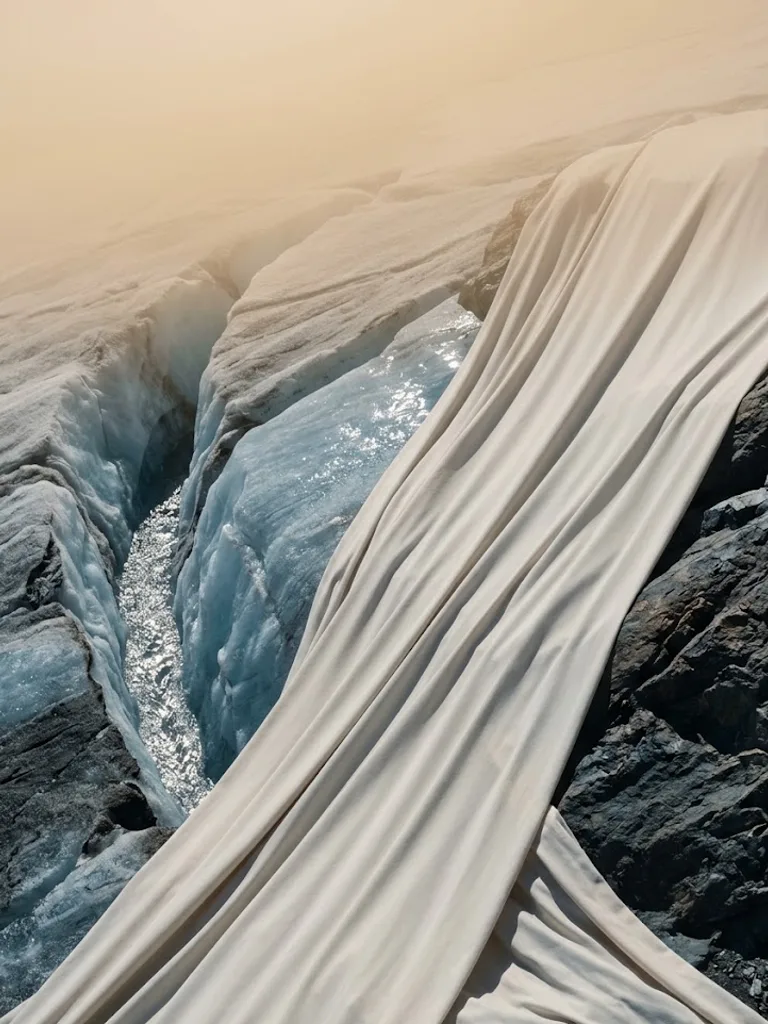
The sheet had torn along the ridge and the white tatters hung down to the ice, still caught on the eastern pegs. Nieves Olagüe reached the pool at a quarter to seven on 2 October 2041, with the first light, and started rolling up what was left intact. Forty metres of wet geotextile weigh as much as a man: you have to do it panel by panel and carry them down one at a time.
Teo Lumbreras had been sitting on the ballast drum since before she arrived.
"You slept at the refuge."
"I slept at the refuge."
He was the hydrologist of the Ésera Water Consortium, the one who measures how much water comes down the river and when, and the one who for five years had signed off that the last ice of the Aneto — what is left of the glacier — was still covered. He came up rarely. When he did, he came up with the Consortium's driver and went down before lunch.
"So you're not here about the sheet," said Nieves.
"No."
He let her roll two panels before speaking. Nieves was grateful for that, because in that job the hands go by themselves and the head is left free, and because what Teo had come to say needed both.
"I've written the closing report. I'm recommending the Consortium doesn't renew. That we stop covering."
Nieves went on rolling. The plastic made its usual noise, a wet crackle, but she heard it differently.
"Give me the number."
"The peak of the Ésera at the Eriste gauging station. In the nineties it was in July. For the last five years it's been in October. I measured it myself, I've checked it three times and I've already had it out with the mayor of Benasque, who told me to find another job. We keep the ice and the village gets through August with the water cut off from nine to nine. It's paying for the water to arrive when it no longer needs it."
"You've known that for two years."
"I've known it for two years and I've written it twice in reports nobody reads, because the same contract asks me to write that and to sign the covered-surface certificate, and the certificate weighs more. This year there's no certificate. The sheet is torn and the season is over. It's the only moment when my report doesn't collide with my signature."
Nieves tied the panel with tape and stood it against the drum. It weighed a fair bit; the night's water doesn't drain off, it stays inside the fabric and you have to carry it down with you. The sun was on the back of her neck now, and below, fifteen hundred metres down, the valley was still in shadow.
"And you need something of mine."
"I need a field annex. Two pages. What you've seen in six years: when the water comes into the pool, when it drains, what time the sheet goes and why, how much ice there was in 2036 and how much is left. Signed by whoever has been up here all six summers, which isn't me."
Nieves knew those two pages without having seen them. She had filled in the site logs herself every evening since 2036, in pencil, in a notebook with swollen covers, and nobody had ever asked her for them.
"Without that your report is a graph."
"Without that my report is a graph drawn by some bloke from Barbastro."
Nieves sat down on the other drum, two metres away. Below, on the moraine, Laia was coming up with the second sack folded over her shoulder.
"Teo, there are eleven of us. And when I say eleven I don't mean a company, I mean eleven payslips with names on them. Altimetría Pirenaica has this, it has two industrial units in Monzón and it has the high-voltage pylons in the valley, and this is what keeps us going from June to October. If the Consortium doesn't renew, the letter arrives in February. And you're not the one who signs that letter. It's signed by a woman in human resources who has never seen the Aneto in her life."
"I'd thought about that."
"Then you already know the month. February."
Teo didn't answer. He bent down, picked up a torn piece of geotextile the size of a handkerchief and started turning it over between his fingers.
Laia Beltrán arrived with the sack and stood listening to the end of it. She was a rope-access technician like Nieves, twenty-six years old and three seasons in; in September she had told the crew this was her last, that she was off to the wind farms in Soria, where the pay is the same and you sleep at home.
"Sign it for him," she said.
Nieves looked up.
"Laia."
"Sign it. My brother runs the farm at Villanova, forty hectares of alfalfa, and this August he got two cuts instead of three. I won't be here in February." She dropped the sack. "And my brother is still there in February."
"Your brother has your crew paying for his irrigation."
"My brother has my crew taking water out of the pool in the middle of August so a bit of plastic doesn't blow away. That's also true."
"Teo. Do you know where the ballast comes from?"
"From the pool."
"You know we take it out of the pool. Do you know when?"
Teo looked up.
"In June and July," she went on. "We assemble at the start of June and we ballast as we lay. Four hundred metres of sleeve, twenty litres a metre. And the tubes don't get emptied until we dismantle, on the twelfth of October. It isn't much water. It's very little. But it's a little June and July water that doesn't go down to the river until October, and we're the ones who take it out, with the pump, in front of everybody, six years running. It's in the site logs. Nobody has ever added it up because nobody thought of it as water: it was ballast."
"Eight thousand litres a season."
"Eight thousand exactly. What forty neighbours use in a day in August. I'm not selling it to you as flow: you've got a graph saying the peak has moved and you haven't got a single written mechanism. That's a mechanism. Small, documented and ours."
Teo held the piece of plastic still in his hand.
"That's page one of the annex."
"That's page one of the annex," said Nieves, "and it's what turns your report from an opinion about the climate into a badly designed job. A badly designed job gets redone. An opinion about the climate ends up in a drawer, and you know that better than I do."
"And the eleven?"
"The eleven are just as sacked if the Consortium renews for two more years and then closes with no alternative work." She got up and shook the water off her gloves. "And there's a difference. If your report goes out with the mechanism in it, it says the job is badly set up, not that nothing needs doing up here. A badly set-up job gets redone. I know how to redo it: gravel ballast flown up by helicopter once a year instead of water pumped every day, and dismantling in August instead of October. That's a new tender. And the people who bid for a new tender are the ones who already know the mountain."
Teo looked at her a second longer than usual.
"You didn't improvise that just now."
"I've been thinking about it since the second summer. I had nowhere to put it."
Laia had sat down on the sack and was laughing without making a sound.
"Two pages," said Teo. "I'll send them over this afternoon."
"Three," said Nieves. "And I'll write them."
"And if the new tender never happens?"
"Then in February the letter comes to me along with the other ten." She put the roll of tape in her trouser pocket. "Send them anyway."
She went down to the pool, put her arm in up to the elbow in the cloudy water and pulled out the end of the ballast sleeve, the one that had spent six summers plugged with a piece of old plastic so the pump wouldn't run dry halfway through a shift. She worked it free with her thumb.
The water began to come out with a fat gurgle and went down into the crevasse below, little and cloudy, for nine minutes.
She swung the last panel onto her shoulder and went down to write the three pages.