 Margen
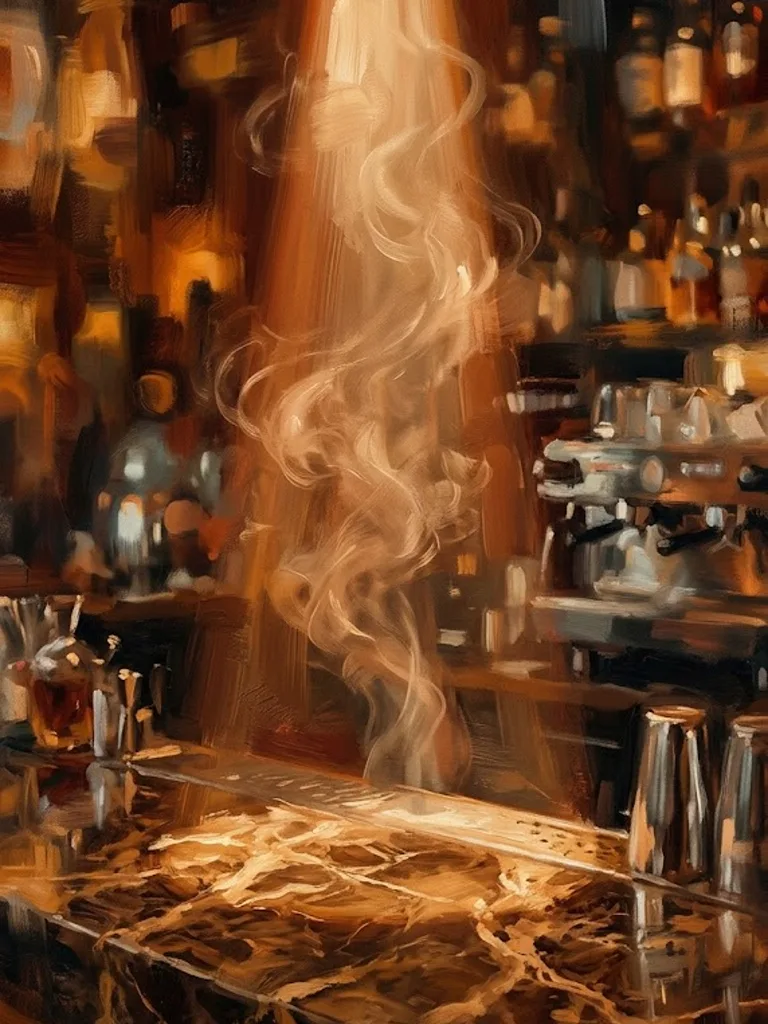
—That isn't beer.
—No, it isn't beer. Good morning.
—I've been pulling pints at this bar for forty years, and that is not beer.
—It's water with a squirt of washing-up liquid and a pinch of salt. The head on real beer dies in ninety seconds and I need it to last forty minutes. I'm Ofelia Calvache, food stylist. The agency pays me so that whatever appears on screen looks appetising from the first shot to the last.
—Bartolomé Mairal. Tolo. The bar's mine.
—I know. Your name appears on the sign at second eleven.
—Then tell me why there's a glass full of washing-up liquid on my bar.
—Because the beer isn't in the advert. The advert is for croquettes. The beer is set dressing, and set dressing can be made up as much as you like.
—And the ice?
—Acrylic. Half the weight and it doesn't sweat.
—And the wet look on the glass?
—Glycerine and water, sprayed. A pass of hairspray first so the drop grips and doesn't run.
—Bloody hell.
—And the parsley you've got there has glycerine too, because it wilts in ten minutes under this light. And the grill marks on the chorizo at the back I did myself with a red-hot skewer, one by one.
—Here, and do people eat that afterwards?
—Nobody eats any of this, Mr Mairal. Except the croquettes.
Ixone Arizkun, the advert's director, clapped twice from behind the camera.
—Take nine. And Ofelia, the front one has collapsed.
—I see it.
—Collapsed, what do you mean collapsed? It's in one piece.
—It's in one piece and it's defeated. Look at the profile. Twenty minutes ago it was a ball and now it's a cushion. The béchamel inside warms up under the light, it slackens, and the croquette sits down. On a big screen that shows enormously.
—And what do you do?
—Change it. I've got a hundred and twenty.
—A hundred and twenty croquettes for a twenty-second advert.
—For four shots of five seconds. The brand brought me six trays and I keep them in a fridge out in the yard. I take them out eight at a time, fry them here, choose the two that came out roundest, and the rest go in the bin. With the croquette I can't touch a thing.
—Why not with that one and yes with the beer?
—Because the beer isn't being sold in this advert and the croquette is. The product being advertised has to be the one that's sold, and the brand and the agency sign that before the shoot.
—So the ice cream in adverts.
—The ice cream in adverts can be mashed potato, I swear I've done it, with colouring and a hot spoon for the swirl. And the milk in cereal was white glue for years, because it's thicker and holds the flakes floating without soaking them.
—Right.
—But if the advert is for the ice cream, it's ice cream. And if the advert is for the milk, it's milk.
—So on this bar everything is fake except the thing they're advertising.
—Everything except the thing we're advertising.
—And the shot of it broken open, how do you do that?
—Which one.
—The croquette split in half. That's the shot. The rest is filler.
—You know that and I know that, and it's the shot we've got at half past twelve. What I do is put a slab of marble under the plate that's been in the freezer out in the yard since eight. The croquette rests on that, it holds firm underneath, I split it with two forks at the same time and I've got eleven seconds before the béchamel makes up its mind to fall. If the camera is ready, we get it. If it isn't ready, I take out another one.
—Eleven seconds.
—Eleven. And I didn't count them: I lost them twelve times until I learned them.
—And the smoke off the griddle at the back?
—A fog machine on its lowest setting, behind the column. The griddle is switched off.
—Madam, in this bar that griddle has been on since 1979.
—Not today, Mr Mairal. Today your griddle is set dressing. And as set dressing it's immaculate.
At quarter to ten a man stopped in the doorway, looked at the camera, looked at the lights and asked if they were open. Tolo told him no from behind the bar, both hands on the cloth, and the man carried on up the street.
—He has a coffee and two croquettes on Tuesdays. Ever since the Jacetania factory closed, on Tuesdays.
—He'll come back tomorrow.
—Tomorrow he comes back. Today I've lost him myself, and today you people are paying for the whole day, so I'm not complaining. But while we're at it, let me tell you something about the ones you're advertising.
—Go ahead.
—That they're a ball of flour. Look. —Tolo broke one in two with his fingers, on the marble—. See that? That doesn't run. Mine runs. Mine, when you break it, goes down your hand.
—I know.
—You know?
—I've been looking at the cross-section of a hundred and twenty of them since seven in the morning. Of course I know.
—Then use mine.
—I can't.
—They're on the griddle, made at six. Real ham and my mother-in-law's béchamel, which meant forty minutes stirring a pan for twelve portions and no complaining.
—I can't, Mr Mairal. And it isn't about you. It's because this —Ofelia pointed at the plate— has somebody else's name on the box.
At twenty past eleven Ixone called for take fourteen. At twenty-two past eleven Ofelia was in the back room with the microwave open and four cotton pads soaking inside, which is what you put behind the plate to make steam rise when the croquette has already gone cold; because real steam lasts thirty seconds and never coincides with the moment the camera is ready.
At twenty-four past eleven she came back with the hot cotton in a pair of tongs, placed it behind, crouched down to check it through the viewfinder and looked at the plate.
—Ixone, stop.
—What's wrong.
—This isn't mine.
Tolo was drying a glass with a cloth at the far end of the bar, not looking at anybody.
—Mr Mairal.
—What.
—Where are my eight?
—In the bin.
—In the bin?
—They were sitting down. You said so yourself.
—Ixone, we're not shooting.
—Ofelia, it's half past eleven and the client was supposed to be here at half past nine.
—I know. And that's why we're not shooting.
But the plate was set, the cotton was steaming, the light had been up since eight, and Tolo's croquette, in the middle of the marble, had a round bottom and a crest of breadcrumbs standing up like a cockerel's comb. Ixone looked at the monitor for three seconds.
—It's the best shot of the day.
—It's the best shot of the day and it's no good.
—We record and then we decide.
They recorded. And as Ofelia opened her mouth to say it again, in came Avelino Pardos, the brand's product manager, coat still on, two hours late.
—Don't tell me. We're going to make it.
—Look at the monitor —said Ixone.
Avelino looked at the monitor. It took him four seconds.
—Whose is that one?
—What do you mean, whose is it?
—That crest. Ours don't rise into a crest like that. —Avelino went over to the marble, picked the croquette up off the plate and broke it open with his fingers. The béchamel ran down to his wrist—. And ours don't run either, Ixone. I've spent nine years explaining to half the world why ours don't run.
And then, to be sure, he ate half of it.
—This isn't ours.
Ixone got to her feet.
—Avelino.
—This isn't ours, Ixone. I've eaten four thousand of them. This one has ham in it.
—Yours have ham in them —said Ofelia—. It says so on the box.
—Ours have ham on the box. This one has it inside.
Nobody said anything for a length of time that was reasonable, given the hour.
—We shoot the plate again with the product —said Ixone in the end—. Ofelia, take eight out of the fridge. Avelino, you're going to have me here until eight and you're going to pay for it.
—I'm going to pay for it.
—And in the wide shot we leave the bar's own tray at the back, out of focus, because it's his and it's his bar.
—In the wide shot I don't care.
By four in the afternoon there were forty of the brand's croquettes left and six empty trays of the other ones, because the crew had eaten and nobody had asked which was which. Avelino Pardos was sitting on the stool at the end, the one that faces the cigarette machine, with a coffee and his notebook open.
—Mairal.
—Yes?
—What do you put in them?
—Ham.
—So do we.
—Right. But we put ham.