 Margen
Did you know? · From the Margen catalogue
A Cessna Flew 64 Days and 22 Hours Without Ever Landing
On December 4, 1958, at McCarran Field in Las Vegas, a white light aircraft with a hotel's name painted on its fuselage took off and would not touch the ground again for 64 days, 22 hours and 19 minutes. It was a Cessna 172, an ordinary four-seater, the kind people learn to fly in, and it landed on February 7, 1959 holding the record for the longest flight in history. No one has broken it since.
Aboard were two employees with earthbound trades. Robert Timm fixed slot machines at the Hacienda hotel in Las Vegas and had flown bombers as a young man; John Cook was a pilot and mechanic by trade, meticulous and quiet. The hotel's owner, a businessman everyone called Doc Bayley, bankrolled the whole operation: he wanted the Hacienda's name in newspapers across the country, and he tied the stunt to a cancer charity drive so the feat would have something more than neon behind it. They christened the plane after the hotel, “Hacienda,” and painted the lettering good and large on the fuselage, sized to match what the joke was costing him.
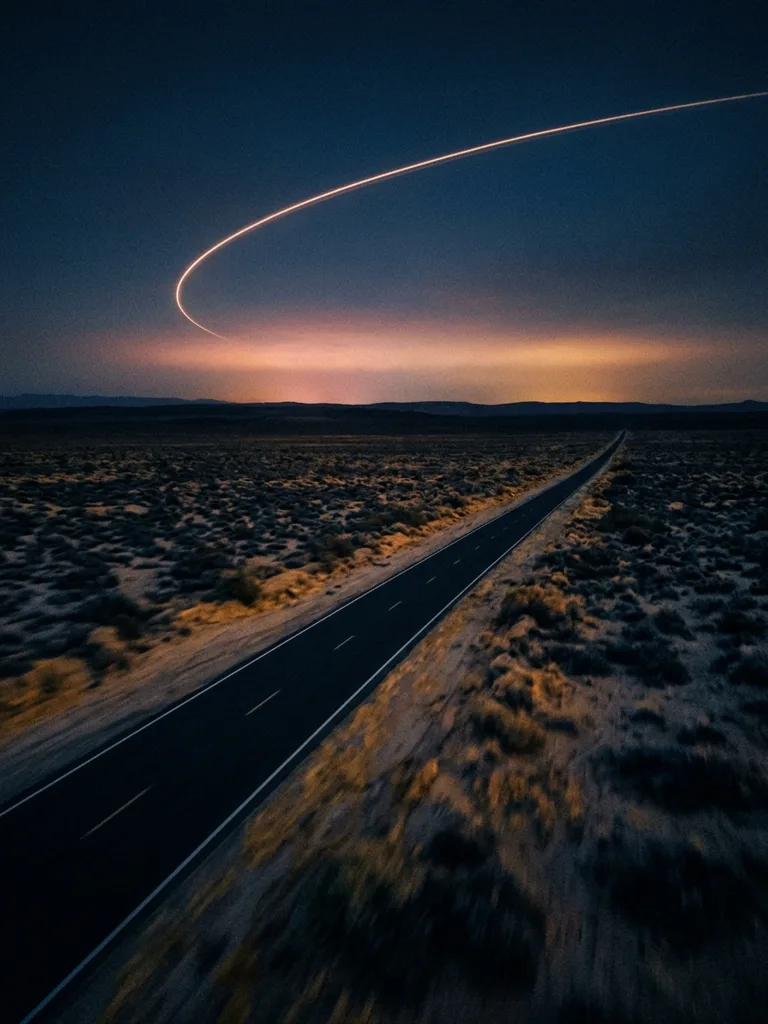
A two-month flight runs into gasoline before it runs into anything else: a Cessna lasts a few hours on a full tank. The solution was so homespun it still astonishes museums. Twice a day, the little plane dropped down low over a lost straight stretch of desert road, many of them near Blythe, on the California line, and flew alongside a pickup truck hurtling down the asphalt. The truck carried a platform with a tank and a fuel pump. Cook matched speeds, Timm lowered a hook on a winch, they hauled up the hose and filled the tanks in about three minutes of steady nerve shared between steering wheel and control stick. Up the same winch, afterward, came hot food, water and clean towels, in a basket. Refueling like that, with the ground a few yards below and the wings full of gasoline, was the one part of the day when neither man spoke. They did it more than a hundred times, twice each day, in wind, in cold, long after the novelty had worn off, and not once did they touch the asphalt.
For the record to count, they had to be able to prove the wheels hadn't grazed the ground for so much as a second in two months. The solution was as handcrafted as the refueling: before takeoff, the timekeepers painted white stripes on the plane's tires. One touchdown, even a three-foot bounce in the middle of the night, would have scrubbed the paint off against the asphalt and given the game away. When the plane landed in February, the committee walked right past the pilots and crouched down to look at the wheels. The stripes were still there, intact, under two months of desert dust.
Inside, the plane was no longer a pleasure craft. The copilot's door had been removed — through that gap came the hose and the basket at every refueling — along with the back seats, replaced by a thin foam mattress the width of an ironing board: one man slept there while the other flew, in four-hour shifts that nobody quite honored after the third week. They carried a small autopilot for the dead hours over the desert, and just as well: Timm admitted afterward that early one morning he fell asleep at the controls and the plane flew on alone, straight and calm, for more than an hour while Cook slept in the back. The Mojave has the virtue of not getting in the way. They washed with a cup of water a day, shaved in flight with a pocket mirror and flicked the lather out the window, and they celebrated Christmas and New Year's circling over the desert, looking down at the lights of a city that bragged it never went dark.
Halfway through the challenge, the engine's generator failed. On any normal flight, that means landing: without a generator there's no decent heating, no proper cabin light, no reliable radio. Timm and Cook decided landing was worse and carried on with a small backup wind-driven dynamo, charging just enough, in darkness through much of the night, with the desert sliding past below at fourteen degrees Fahrenheit. By then the press was counting the days, and Doc Bayley's hotel was in the papers exactly as he had calculated.
It was the engine that ended the flight. After two months running without pause, more than a thousand straight hours on the crankshaft, the built-up carbon had eaten away so much power that the plane, tanks full, could barely claw for altitude after each refueling. That narrowing margin was the only alarm Timm and Cook were willing to hear. On February 7, 1959, they set the wheels down at McCarran again, in front of the cameras, bearded like castaways, their legs so numb they had to be helped out. Cook was asked shortly afterward whether he would do it again, and his answer went into the airport's archives: the next time he felt the urge to break an endurance record, he said, he would shut himself in a garbage can with a vacuum cleaner running until the psychiatrist's office opened. They had taken off with the Christmas lights freshly hung and landed with the long slog of January behind them: 64 days, 22 hours and 19 minutes, and a distance flown equal to six times around the world without ever leaving Nevada.
The record still stands more than sixty years later: there is no shortage of better airplanes, and it has never been worth anyone's while to do that to two men and an engine again. Anyone who wants proof doesn't have to go to an archive. The “Hacienda,” restored with its lettering and its tail number, hangs today from the ceiling of the terminal at the Las Vegas airport, the old McCarran, a few yards from slot machines like the ones Robert Timm used to fix back when nobody had yet thought of the pickup truck.