 Margen
Serialized book · From the Margen catalogue
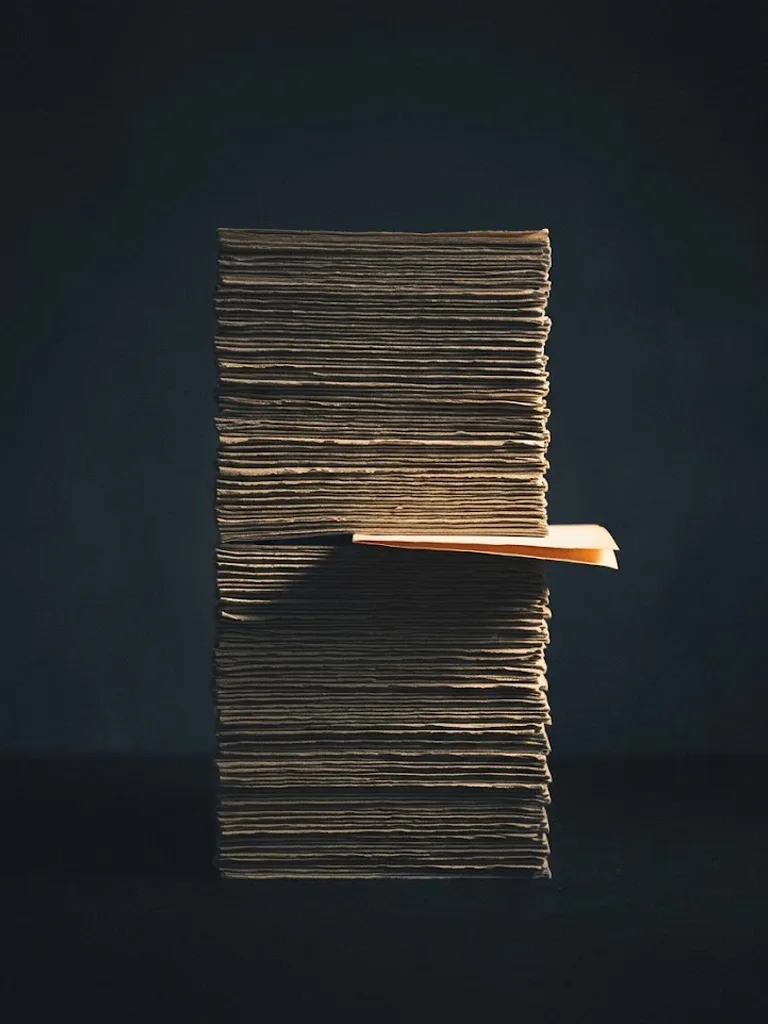
Two hundred and thirteen books go up on the truck
Previously: On the 18th the National Registry approved shared authorship of 'Winter Trades', file 2038/1174: Herminia Sasal Nogueras and Casimiro Lete.
At six in the morning on 19 June there were zero titles left to verify. Two hundred and fourteen were stacked on the rear dock of the Provincial Library of Huesca, and one of them, the one the system had listed as destroyed since 14 March, was waiting to one side, on top of a folder.
The two trucks backed in fifteen minutes apart. The wall clock in the room, eleven minutes fast since March, read six eleven when Fabián Oyarzun, floor manager and the man responsible for the cull, signed the batch out.
'Two hundred and thirteen,' he said. 'Count them yourself as well.'
Ainhoa Cortabarria, the library's restorer, counted them. She had verified them one by one over eighteen days: one hundred and ninety had a second copy in another province and twenty-four had none anywhere. The twenty-four went up all the same. Article nine of the campaign regulations allowed one to be withdrawn. One per campaign, per province.
The one staying behind had a green label stuck inside the back cover with two lines printed that night: HERITAGE COPY — CAMPAIGN 2038 — HUESCA, and the file number underneath. Not pulped, not counted in the weight, never back to deduplication.
Remei Balaguer got down from the second truck with the signature folder. She is an operator at the pulp plant in Sabiñánigo and has spent nine years signing destruction records. She signs them by weight: the dock scale gives the kilos and the program infers the titles. In March one thousand nine hundred kilos came in and the record declared four thousand one hundred titles, and by that arithmetic copy 215 was listed as destroyed while it sat on a trolley a hundred and ten kilometres away.
'I've got the list,' said Ainhoa, and put seven stapled sheets in front of her. 'Two hundred and thirteen, with shelfmark and title. Counted.'
Remei read the whole first page, which was more than she had ever read on a loading dock at half past six in the morning.
'I can't stop the line,' she said. 'On the 22nd we go into maintenance for three weeks, and whatever doesn't arrive today sits in the yard until July.'
'I'm not asking you to stop it.'
Remei took out her pen and wrote the record by hand, on top of the printed one. Where the program left a single box, she put two: GROSS WEIGHT, 1,870 kilos. TITLES, 213. She signed the two lines separately and handed Fabián the pink copy.
'I've never done this before,' she said.
'And will it stand?' asked Fabián.
'It'll stand for what it's worth. But the number going up to Madrid this time is the real one.'
She stapled the seven sheets behind her copy and put them in the signature folder.
'This goes up with the load,' she said. 'If Madrid wants the weight, there's the weight. If they ever want to know how many books it was, there are the titles, one under the other. What happened in March, nobody can fix now.'
'No,' said Ainhoa.
'Then let it be the last time a number comes out of a scale.'
At twenty past seven the trucks pulled out up the ramp. Otilia Bergua, cataloguer of the old collection, watched them go from the doorway with her hands in the pockets of her coat. She has four thousand two hundred uncatalogued titles in the basement and has been allowed to save four hundred, and since Tuesday she has had the number 2038/1174 written on the first page of her notebook, the closest thing to a precedent that exists.
'I've learned it by heart,' she said. 'In case they argue with me in September.'
Ainhoa rang Ayerbe at ten past eight. Casimiro Lete Arbués, eighty-nine years old, author of the 1974 book, picked up on the fourth ring.
'Did it go through?' he asked.
'It went through. With both names.'
'In what order?'
'The order in the file. Her first.'
Casimiro took a few seconds to answer and then asked what the weather was like in Huesca. They talked about that until he hung up.
When a book changes category its card has to be made again from scratch, so at nine Ainhoa typed a new one on a blank card: shelfmark, title, Tramullas press, Huesca, 1974. On the author line she wrote what had been printed there ever since: Casimiro Lete. The card form has no second author line; it has one, and a blank space underneath for notes.
The legal order lives somewhere else. In file 2038/1174 of the National Registry, under authorship, Herminia Sasal Nogueras comes first and Casimiro Lete Arbués second, which is how he asked for it in writing and how it was approved on the 18th at twenty to eight in the evening. On the library card the printer's order rules, because the card copies the printer. Both are true: one says who wrote the book and the other says who signed it in 1974.
At half past nine the room still smelled of empty pallets. Fabián picked the seals up off the floor, switched off the dock scale and noted in the internal log that the 14 March entry relating to copy 215 was annulled by file 2038/1174. It took him two minutes to write. It was the same system that three months earlier had declared the book destroyed without anyone looking at it.
Ainhoa wrote Herminia Sasal's name by hand in the notes space, in the same small lettering she uses to label restoration boxes, and went over it in ink so it would not rub away.
Copy 215 went back into the room with a new card, and on the author line, underneath Casimiro Lete, was written the name of Herminia Sasal.