 Margen
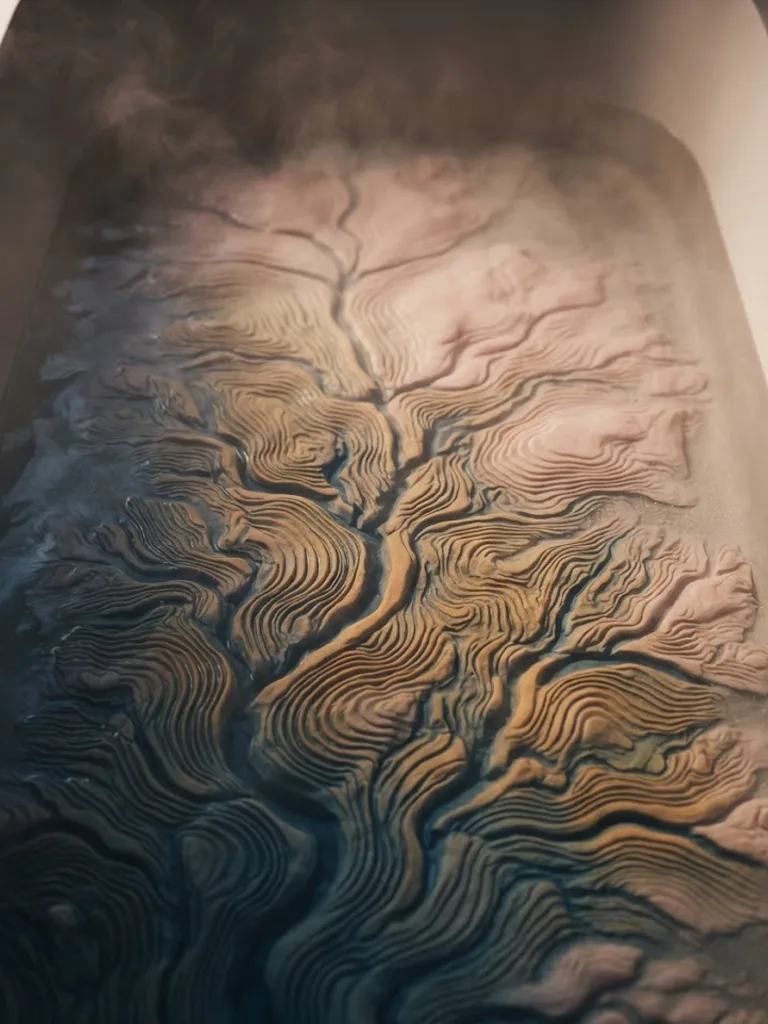
2014, Berlin. Forty volunteers held their hands for half an hour in water at forty degrees and took them out with the fingertips pleated. That pleating is ordered by the sympathetic nervous system. What Gary Lewin's laboratory, at the Max Delbrück Center for Molecular Medicine, wanted to find out was what it is for.
After the bath, the forty set about moving marbles, dice and brass weights from one container to another through a five-centimetre opening, sometimes dry and sometimes submerged. With pleated fingers they did no better. They also measured tactile acuity separately, pressing gratings with ever closer grooves against the fingertip and asking which way the grooves ran, and that did not improve either. The paper came out in PLOS ONE: water-induced wrinkles do not improve touch or dexterity in handling wet objects.
That was arguing with what had been published the year before.
2013, Newcastle. Kyriacos Kareklas, Daniel Nettle and Tom Smulders asked twenty people to pass thirty-nine glass marbles and six lead fishing weights from one container to another, with dry hands and with hands after the same half-hour bath. With the objects submerged, wrinkled fingers did the job about 12 % faster. With dry objects, no advantage at all. Each volunteer went through both conditions, dry-fingered and pleated, so that each was their own control, and the order was randomised so that practice at the task would not count. They published it in Biology Letters, and it was the first time anyone had put a number on the idea that the wrinkles are for something.
The idea was two years older.
2011. Mark Changizi, a theoretical biologist, and three colleagues looked at the shape of the pattern. The wrinkles on a fingertip are neither a whorl nor a grid: they are channels that run out from the centre of the finger and down towards the edges, joining one another and never closing into an island. That is the topology of a drainage network, of river basins seen from above, and also of the tread on a wet-weather tyre: a system for letting water escape underneath when you press. They called them "rain treads" and published it in Brain, Behavior and Evolution. Changizi added an argument that was not about shape but about family: water pleating is documented in macaques too, and a trait that turns up in other primates looks more like an inherited function than a fault in the skin.
The nineteen-seventies. Water wrinkles enter neurology and hand-surgery clinics as a diagnostic test. It is called, without embellishment, the wrinkle test: the hand goes into water at around forty degrees, you wait half an hour and you look at which fingers pleated and which did not. It works with small children and with patients who cannot cooperate in a nerve conduction study, because they do not need to understand anything, or put up with an electrode, or say whether they feel something.
What makes it reliable is not the fineness of the instrument, since there is no instrument, but that every person carries their own control group: you compare the matching fingers of both hands, dipped at the same time, in the same water, for the same length of time. And the other way round: the day a surgeon wants to know whether the nerve he stitched nine months ago has gone back to commanding the vessels of that fingertip, he has a basin and half an hour.
The skin of the fingertips, of the palms, of the soles and of the inner face of the fingers has no hair: it is glabrous skin, and it is the only kind that wrinkles. After three to five minutes in water, fibres of the sympathetic nervous system order the blood vessels just beneath that skin to narrow. As they narrow, the volume of what lies underneath drops a little. And the skin, anchored to the tissue below by thousands of tiny ligaments and unable to shrink freely, does the only thing it can do: it buckles into ridges and furrows. Warm water manages it far sooner than cold water does, and laboratories leave the hand in for half an hour because they want the pleating complete and not its first hint. When you pull your hand out, it takes ten to twenty minutes to go back to normal.
The same nerves that give that order are the ones that open the sweat glands in that same skin, and they travel together: a finger that does not sweat does not wrinkle either. That is why patients operated on for excessive sweating of the hands — a thoracic sympathectomy, which consists precisely of interrupting that pathway — also lose the wrinkling in the treated hand. Nothing is wrong with their skin. What is missing is the cable.
And the opposite fault exists, called aquagenic wrinkling of the palms: hands that pleat within two or three minutes and do so excessively, the skin whitish and looking like a soaked glove, out of all proportion to the time spent in the water. It has been described above all in people with cystic fibrosis and in carriers of the gene, and it fits the story: in that disease the transport of salts across the skin is altered, and it is the salts that govern the water.
From which follows something you can check in a bathtub. If the pleating were water getting into the skin, the back of the hand, the forearm and the back would wrinkle too, and they do not; temperature would make no difference, and it does; and there would be no way to take the right hand out pleated and the left one smooth from the same basin, at the same moment and with the same soap.
That last part is what the first people to look at it saw.
1936. Thomas Lewis and George Pickering published in Clinical Science a study of circulatory changes in the fingers of patients with diseases of the nervous system. Among other things, they put into water the hands of people with an injured median nerve. The fingers that depended on the damaged nerve came out of the water smooth. Those of the healthy hand came out pleated, from the same basin, at the same temperature and for the same length of time. Ninety years later that is still the experiment repeated in clinics, and everything needed to set it up is a basin, hot water and a watch.