 Margen
Short story · From the Margen catalogue
Amparo records the F that has been flat for a century
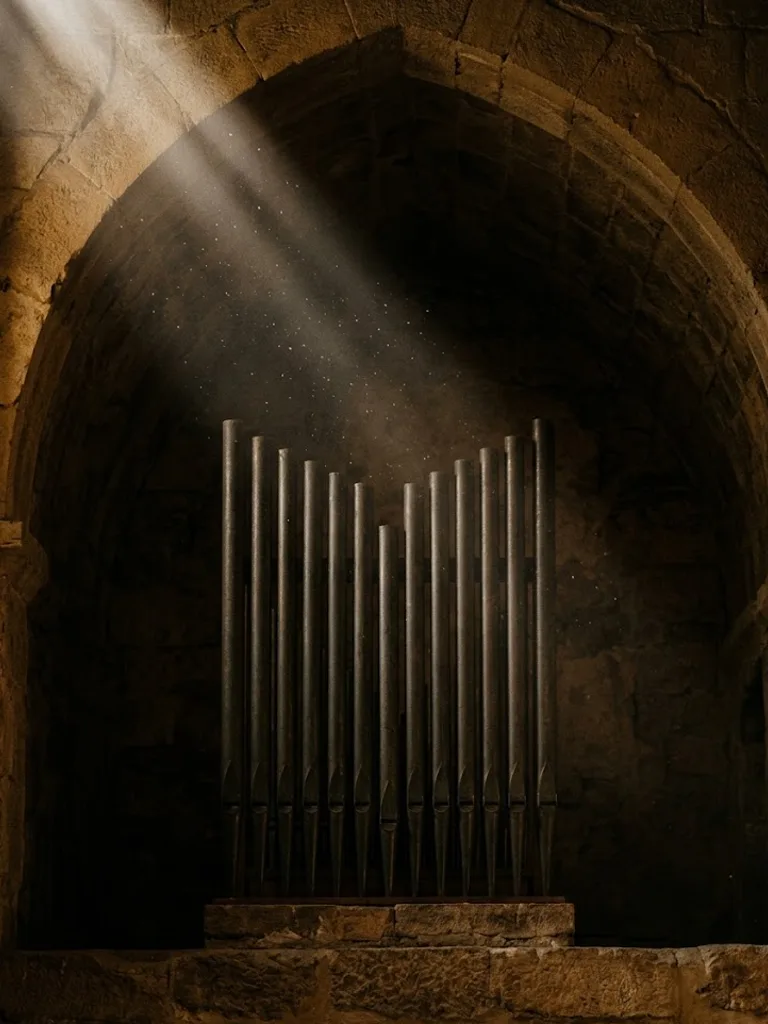
SESSION LOG 14/B — Organ of the collegiate church of Santa Práxedes de Valmorisco, built in 1742. Full sampling for the Register of Retired Instruments. Technician in charge: Amparo Belaunde, sound engineer. Present: Honorato Lecea, titular organist since 1975; Casimiro Belaustegui, the diocese's authorised representative. Legal warning printed at the head of the log: once the sample certified in this session is registered, the organ may be dismantled and the sample replaces it for all purposes.
06:40. I let myself in with the key they left me last night. Fourteen degrees inside, seven outside. I leave the microphones in place and the room shut for two hours so the wood stops moving.
08:55. Honorato Lecea sits at the bench. He is eighty-five and has spent fifty-one years playing this organ. He asks me not to record the first twenty minutes because, he says, the instrument needs that long to be there.
09:20. First usable take. Eight-foot principal, the stop that gives the note as it is, full scale, note by note, three seconds a note and four of decay.
09:34. Take 11 discarded. On the F of the second octave the microphone's tuner gives me 339 hertz and it should give 349. That is fifty cents flat: a quarter tone, exactly.
09:36. I repeat. Same F, same value, and the rest of the stop is within two cents: thermal drift is ruled out.
09:41. I tell Honorato. He answers without looking up from the keys:
"That's the third one in the row. The plaster that came down over the choir in September 1911 took it with it, and they rebuilt it that autumn. It has sounded flat ever since."
"And you play it the same?"
"I don't play it. On that F I go up to the one above and drop my left hand. Don Julián Abaigar taught me, he was the organist when I was fourteen, and the man who soldered the pipe taught him. In this house that F has not been played in a hundred and fifteen years."
I note it down because it changes the session: I am recording an organ with a hole that two organists in a row have learned to go around, and that is going to end up inside the sample.
10:05. Casimiro Belaustegui asks to see the log. He reads the line about the F and puts the following to me in writing, which I transcribe verbatim:
"The agreement requires fidelity to the instrument in its present state. A pipe that broke during works in 1911 is a fault, and the agreement obliges me to certify an instrument in sound condition. If we certify the sample with the defect inside it, the nine parishes that are going to buy this sample for their own dismantlings inherit a broken F that was never theirs."
10:12. I reply that what he is asking for is a recording of an instrument that does not exist today.
10:14. He proposes a technical way out: tune the pipe this very morning — the organ builder needs forty minutes — record the correct F, and then return it to its state so the protected asset is untouched. The organ stays as it is and the sample comes out clean.
10:15. Honorato hears the proposal and comes down from the bench. It is the first time all morning he has spoken away from the keys.
"If they tune that F, the one that sounds wrong is the one next to it."
"Why?"
"Because it was made for this. Ask Don Rodrigo."
10:31. I ring Don Rodrigo Mazariegos, the organ builder for the district, sixty-two, who runs the workshop his family opened in 1894.
10:45. He arrives with a toolbox and a folder. The first thing he says, before looking at anything, is that tuning a pipe for a recording and putting it back afterwards strikes him as a way of lying twice.
11:05. Inside the windchest case, the wooden box that distributes the air to the pipes, glued with rabbit-skin size to the inner face of the board and protected by a batten, there is a handwritten note in ink, dated 2 November 1911 and signed by Fructuoso Mazariegos, Don Rodrigo's great-grandfather. I photograph it and transcribe it in full:
"Third pipe of the principal, F, rebuilt. Lowered by a quarter tone on purpose, by order of the chapter and with my agreement. The true F sets the vault singing and in September plaster fell over the choir twice. Measured with a tuning fork and with the ears of four men. Let whoever comes be warned."
11:15. Don Rodrigo opens the workshop folder and looks for the 1911 entry. It is in the third ledger, in his great-grandfather's hand and with the price: fourteen pesetas for the pipe and six for the soldering. He also shows me how you lower a principal pipe without changing its body, which is what was done then: you lengthen the mouth at the top with a tongue of tin, soldered by hand, and the pipe starts sounding lower without anything showing from outside. He measures it with callipers in front of me. The tongue is still there, it is fourteen millimetres and it is soldered with the same tin as the rest of the row.
11:20. Check. The same F exists in tune on another of the house's stops, so I ask Honorato for that one, held for twelve seconds. At nine seconds the vault microphone starts to rise and at eleven seconds it is eight decibels above the rest of the take, with a clean peak at the note's own frequency. The stone answers, and it is in the file: you can see the peak and you can measure it.
11:24. I repeat with the flat F of 1911. The vault microphone does not move.
11:30. For the record, here is what that means. The pipe is not broken. In 1911 an organ builder and a chapter measured that this nave gives that exact note back amplified, and they lowered the pipe by fifty cents to get out of the resonance. It has spent a hundred and fifteen years doing the job it was rebuilt for.
11:35. Casimiro Belaustegui asks that his position be recorded and I copy it: he accepts the 1911 note, but holds that the finding strengthens his request, because the nine buying parishes do not have this vault and the flat F, in their naves, will be a flat F and nothing more.
11:40. This is what I decide, with the authority the agreement gives me and the responsibility that comes behind it.
Decision 1. The certified sample is recorded with the instrument as it stands today, F included, and the 1911 note is digitised and attached as a document of origin, with the 11:20 measurement and the two vault takes. Whoever buys this sample is going to open the file and find, before the first note, why that F sounds the way it does and what happens if they correct it.
Decision 2. The tuned F is also recorded, on a separate track labelled as a reconstruction. It does not go into the certification. It goes in so that a parish without a stone vault can use it knowing that it is using it.
11:52. I read it to Honorato before closing the log and he asks me for one more thing, which I grant and which I note down: to record, at the very end, the flat F played by him, alone, with Don Julián's fingering, the one that goes up to the note above and drops the left hand.
12:06. Take 51, the last. It runs forty-one seconds. I leave it whole and unedited at the end of the file, behind the two seconds of courtesy, and I label it with his name, his trade and the fifty-one years.
12:15. I close the session. Fifty-one takes, fourteen stops, a document from 1911 and two tracks of the same F. Tomorrow they come to dismantle the pipes and number them one by one, and the organ of the collegiate church of Santa Práxedes de Valmorisco will become this file. I hand in the signed log at 12:20 and I keep a copy.